
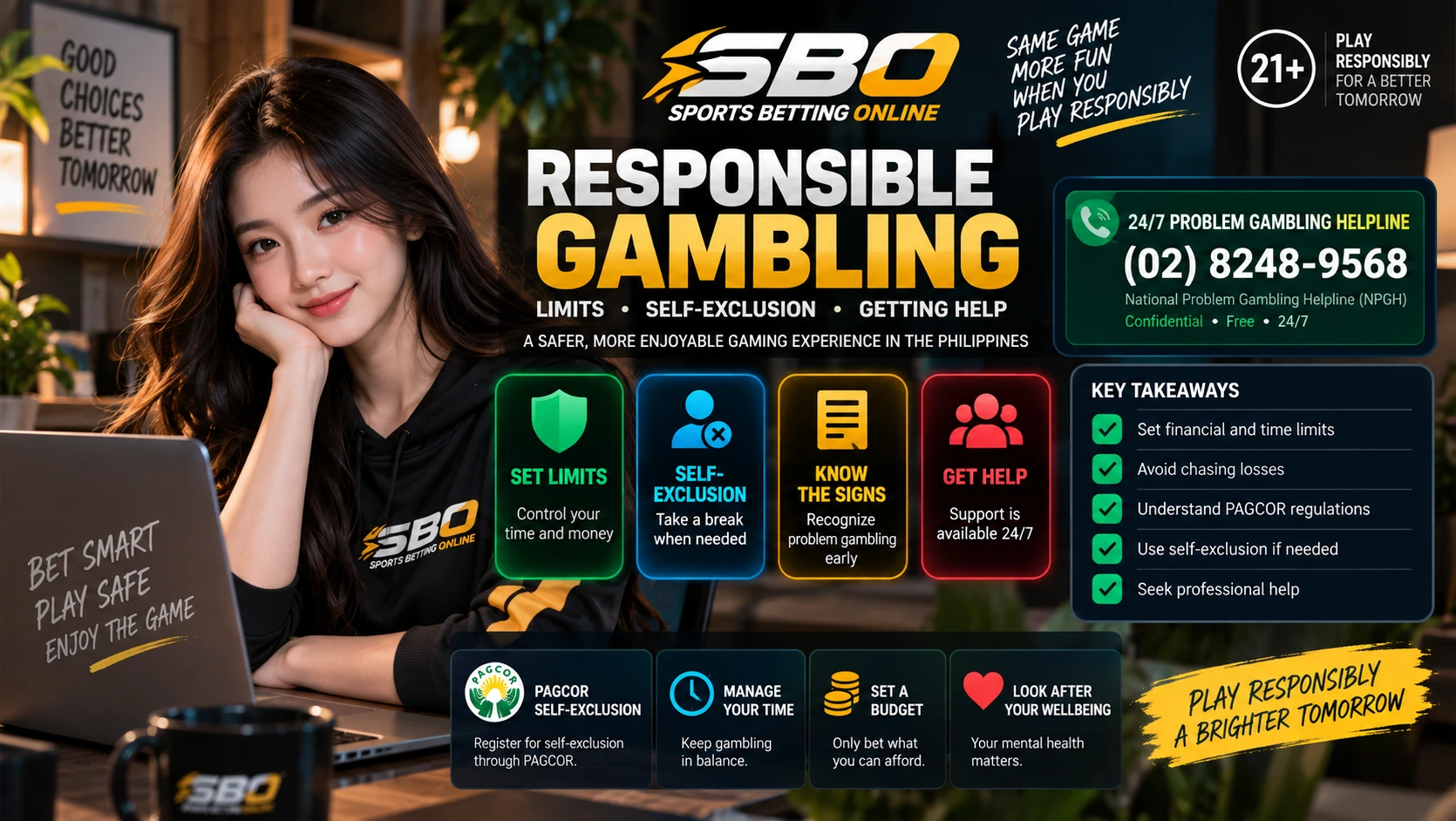
In the Philippines, the Philippine Amusement and Gaming Corporation (PAGCOR) states that people under 21 years old are not allowed to gamble. Its Responsible Gaming Code is intended to reduce gambling-related harm, prevent addiction, and restrict participation by prohibited persons.
Responsible gambling should not be interpreted to mean that gambling is safe or profitable. Sports results remain uncertain, losses are possible, and no budgeting system can guarantee financial protection. For broader regulatory context, consult our legal and safety guide and review our editorial policy regarding objective consumer protection.
Responsible gambling is about preventing harm rather than improving betting results. Key protections include keeping gambling away from essential household finances, recognizing harmful behaviour early, using exclusion controls when needed, and seeking confidential support before a financial or personal crisis develops.
What Does Responsible Gambling Mean?
Responsible gambling focuses on reducing the potential harm caused by gambling activity. It does not refer to a strategy for winning more often.
Instead, responsible-gaming frameworks commonly address issues such as:
- Age eligibility: Enforcing strict minimum-age verification barriers to protect youth.
- Financial exposure: Establishing clear boundaries to ensure gambling never compromises essential household living needs.
- Time spent gambling: Preventing continuous session lengths that disrupt sleep, family life, or professional obligations.
- Access to gaming services: Creating physical and digital barriers that allow individuals to step away.
- Self-exclusion: Enabling formal, enforceable bans across regulated venues and digital platforms.
- Consumer information: Providing accurate mathematical odds disclosure, eliminating deceptive marketing slogans.
- Support services: Connecting players and families directly to trained, confidential counselling resources.
PAGCOR states that its Responsible Gaming Code of Practice is intended to minimize harm to players and communities and prevent gambling addiction.
Who Is Not Allowed to Gamble in the Philippines?
PAGCOR's current responsible-gaming information lists several categories of restricted persons. In regulated Philippine venues and platforms, the following individuals are strictly prohibited from participating in gaming activities:
- Minors & Young Adults: Persons under 21 years old.
- Government Officials & Employees: Certain public officials and civil servants covered by applicable civil service laws, ethics codes, and executive directives.
- Uniformed Services: Active members of the Armed Forces of the Philippines (AFP) and the Philippine National Police (PNP).
- Excluded Persons: Individuals included in the National Database of Restricted Persons (NDRP) via voluntary self-exclusion or family-exclusion orders.
- Gaming Industry Licensees: Gaming Employment License (GEL) holders directly employed by gaming establishments or operators.
The specific rules can change, so eligibility should always be checked against current official PAGCOR information. For readers below the legal age, the rule is straightforward: do not participate in gambling activity.
Why Financial Limits Matter
Gambling inherently involves the possibility of losing money. Financial boundaries are intended to prevent those losses from affecting essential areas of life.
Money needed for food, housing, education, transport, healthcare, utility bills, debt repayments, emergency savings, or family responsibilities should never be treated as gambling money.
Borrowed money—whether through personal loans, salary advances, credit cards, pawnshops, or lending apps—creates severe compounding danger. When borrowed money is wagered, a gambling loss immediately transforms into both a financial loss and an interest-bearing debt obligation that threatens long-term security.
A spending boundary also should not be treated as permission to keep gambling until the entire amount is gone. Its purpose is harm reduction. For an in-depth look at managing personal bankrolls responsibly, see our guide on bankroll management and gambling limits.
Why Time Limits Matter Too
Financial loss is not the only form of gambling-related harm.
Excessive time spent gambling or constantly monitoring sports markets can interfere with sleep, schooling, employment, relationships, personal hobbies, and everyday responsibilities.
Someone may remain within an arbitrary financial boundary while gambling occupies increasing amounts of their mental attention, focus, and waking hours. Responsible-gaming controls therefore need to consider time as well as money.
Why Chasing Losses Is a Warning Sign
Chasing losses means continuing or increasing gambling activity in an attempt to recover money already lost. The internal rationale often sounds like:
The mathematical and psychological reality is that previous losses do not change the probability of the next sporting result. A new event remains completely independent and uncertain. Continuing to wager simply because of earlier losses increases total financial exposure, escalates cognitive distress, and makes it substantially harder to stop.
Gambling Should Not Be Treated as Income
Sports betting does not create a predictable salary or guaranteed return. Even experienced sports analysts and mathematical modelers cannot eliminate sporting uncertainty.
Numerous unpredictable variables continually affect sporting outcomes:
- Sudden athlete injuries or game-time physical limitations.
- Unexpected individual performances and statistical variances.
- Controversial officiating, refereeing errors, and VAR/replay reviews.
- Adverse weather conditions (heavy rain, extreme heat, wind shifts).
- In-game tactical adjustments and unexpected coaching substitutions.
- Random bounces and statistical noise inherent to competitive athletics.
Claims involving guaranteed profit, sure wins, locks, or risk-free income should therefore be treated skeptically. No responsible-gambling framework can turn uncertain outcomes into guaranteed earnings.
Warning Signs of Gambling-Related Harm
Individual experiences vary, but concern is warranted whenever gambling starts negatively affecting everyday life. The following table details recognized warning signs and explains why each requires immediate attention:
| Warning Sign | Why It Matters |
|---|---|
| Chasing previous losses | Increases total financial exposure by betting emotionally to recover sunk costs rather than stepping away. |
| Borrowing money | Converts gambling losses into interest-bearing debt, straining personal relationships and financial solvency. |
| Using essential funds | Jeopardizes basic living needs, including food, housing rent, tuition, healthcare, and monthly utility bills. |
| Hiding gambling activity | Indicates loss of personal control, shame, or distress, preventing open communication with loved ones. |
| Breaking established boundaries | Demonstrates that voluntary financial or session-length limits are failing to restrain impulsive wagering. |
| Spending increasing time gambling | Disrupts school, career performance, sleep hygiene, social life, and domestic obligations. |
| Gambling to escape problems | Treats wagering as emotional avoidance for stress, anxiety, or depression, which deepens underlying difficulties. |
| Continuing despite harm | Clearly signals that self-regulation has deteriorated and stronger formal safeguards (such as exclusion) are needed. |
A person does not need to wait until the situation becomes severe before seeking support. Early intervention significantly improves personal and financial outcomes.
What Is Self-Exclusion?
Self-exclusion is a formal consumer-protection mechanism that allows someone to voluntarily restrict their own access to regulated gambling venues and online platforms.
PAGCOR currently provides a structured self-exclusion program for people who feel they are developing a gambling problem. Under current public exclusion guidelines:
6-Month Exclusion
Short-term voluntary restriction. The first six months of self-exclusion are strictly irrevocable to prevent impulsive reversals during moments of vulnerability.
1-Year Exclusion
Medium-term ban offering substantial distance from all regulated gaming facilities and licensed digital sportsbooks across the country.
5-Year Exclusion
Extended long-term exclusion intended for individuals requiring extensive lifestyle and behavioural restructuring.
PAGCOR states that excluded persons are formally registered into its National Database of Restricted Persons (NDRP), ensuring that all licensed gaming operators are mandated to enforce access bans.
Self-exclusion is not a punishment. It is a harm-reduction tool intended to create psychological and physical distance between the individual and gambling activity.
What Is Family Exclusion?
PAGCOR also provides a dedicated family-exclusion mechanism. Current PAGCOR guidelines state that eligible exclusion applications may be initiated by immediate family members:
- A person's legal spouse.
- A parent.
- A child aged at least 18 years old.
This safeguard provides a critical recourse when gambling behaviour is causing financial devastation or severe emotional harm not only to the individual, but also to their household. Because specific documentation requirements can change, the latest application procedure should be verified directly through PAGCOR's official regulatory portal before relying on older guides.
What Is the National Database of Restricted Persons?
PAGCOR maintains the National Database of Restricted Persons, commonly abbreviated as the NDRP.
The database includes individuals restricted from gaming activities for several distinct legal, regulatory, and personal reasons. In addition to individuals registered under voluntary self-exclusion or family-exclusion orders, it includes prohibited public employees, law enforcement personnel, and regulatory ban lists.
It should not be described simply as a database of people with gambling addiction. PAGCOR has specifically clarified that many people included in the NDRP are restricted purely for legal, constitutional, or employment status reasons rather than because they have been diagnosed with problem gambling.
Philippines 24/7 National Problem Gambling Helpline
On May 26, 2026, PAGCOR officially launched the National Problem Gambling Helpline (NPGH).
Operating 24 hours a day, seven days a week, the helpline connects callers with trained counsellors who provide confidential, professional support for people experiencing gambling-related difficulties, as well as their affected family members.
PAGCOR confirmed that the service was established in partnership with the Seagulls Flock Organization Inc., a recognized organization specializing in mental health, dependency treatment, and psychological rehabilitation support.
When Should Someone Consider Getting Help?
A person does not need to hit rock bottom or reach a catastrophic financial crisis before seeking support. Help is appropriate whenever:
- Gambling feels increasingly difficult or impossible to control voluntarily.
- Predetermined financial or session-duration boundaries are repeatedly breached.
- Losing sessions prompt immediate impulses to wager more in order to break even.
- Money is being borrowed, possessions are sold, or bills are deferred to fund betting.
- Gambling habits are hidden or lied about to family members, partners, or colleagues.
- School assignments, job attendance, career productivity, or domestic duties are neglected.
- Gambling is accompanied by persistent guilt, anxiety, irritability, or depressive moods.
Getting support early prevents compounding debt and protects interpersonal relationships. For anyone in the Philippines experiencing these symptoms, calling the National Problem Gambling Helpline at (02) 8248-9568 is a secure and discreet first step.
Responsible Gambling Is More Than a Budget
A common misconception is that responsible gambling simply means limiting the money wagered on any individual sporting event.
While setting stake ceilings is prudent, financial budgeting is only one facet of harm prevention. An individual can technically stay within a per-event budget while gambling dozens of times daily, losing sleep to track late-night overseas fixtures, concealing activity from loved ones, or suffering intense emotional distress over accumulated losses.
Responsible-gaming safeguards must evaluate the holistic pattern of behaviour—including cognitive preoccupation, emotional reliance, and social withdrawal.
Why Percentage-Based Bankroll Rules Are Not Enough
Techniques like the conventional 1% to 5% unit rule are frequently marketed as responsible-gambling solutions.
In reality, percentage rules are financial risk-management concepts for sports bettors, not behavioural safeguards. They cannot guarantee:
- That cumulative losses over hundreds of wagers will remain inconsequential.
- That a bettor will maintain discipline and stop when emotionally triggered.
- That repeated high-volume participation will not erode essential savings.
- That compulsive or addictive behaviours will not take root.
A percentage rule adjusts only the monetary stake of a single ticket. It has zero power over human psychology or the inherent uncertainty of sports outcomes. To understand how staking models operate within their limited financial scope, consult our bankroll management and gambling limits resource.
How Marketing Can Affect Gambling Behaviour
Digital sportsbooks utilize aggressive promotional tactics, including push notifications, limited-time countdown timers, gamified loyalty tiers, deposit match bonuses, and social media ads promoting astronomical potential payouts.
This manufactured sense of urgency should never override personal financial or temporal boundaries:
- An expiring promotional window does not obligate participation.
- A tiered VIP status or loyalty cashback does not offset net financial losses.
- An advertised 1,000-to-1 accumulator return reflects near-zero statistical probability, regardless of promotional phrasing.
For a clear consumer audit of the wagering requirements, rollovers, and restrictions attached to promotional offers, review our detailed sportsbook bonus terms explained guide.
Responsible Gambling and Mobile Access
Modern smartphones place 24/7 sports betting markets inside the user's pocket. This frictionless convenience dissolves the natural friction and separation that historically existed between betting venues and normal domestic life.
Alerts and live-odds notifications can arrive during work hours, family meals, travel, or late at night. Effective harm-reduction measures include:
- Disabling all push notifications from betting applications and sports scores apps.
- Removing saved credit cards, biometric instant deposits, and linked e-wallet autofills.
- Establishing device-level screen-time restrictions on gambling websites.
- Recognizing when casual sports viewing has become overshadowed by compulsive odds checking.
The objective of responsible gaming is to reduce personal exposure and harm—not to make gambling faster or more efficient.
What Family and Friends Can Do
Gambling-related harm rarely occurs in isolation; it impacts spouses, children, parents, and close colleagues. Family members are often the first to observe subtle behavioural indicators—such as sudden secrecy with financial accounts, unexplained borrowing, mood swings following sports matches, or increasing absenteeism.
When addressing these concerns:
- Approach conversations with calm, observable facts rather than accusations or shame.
- Encourage the individual to review their transaction statements objectively.
- Discuss setting firm household financial controls to safeguard shared bank accounts.
- Explore PAGCOR's formal family-exclusion program if voluntary measures fail.
- Reach out to the 24/7 National Problem Gambling Helpline at (02) 8248-9568 for confidential family counselling guidance.
Common Responsible-Gambling Myths
Misconceptions about gambling behaviour can prevent individuals from recognizing early harm. Here are five pervasive myths contrasted with reality:
“I only bet on sports I know well, so I am completely safe.”
Deep sports knowledge does not eliminate bookmaker margins, referee mistakes, player injuries, or unpredictable athletic variance.
“Small wagers cannot turn into a harmful gambling problem.”
High frequency and continuous mental preoccupation cause severe emotional and temporal harm regardless of individual ticket size.
“I can easily recover my losses if I just double up my next bet.”
Past outcomes have zero mathematical influence on future sporting fixtures. Chasing losses reliably deepens net debt.
“Self-exclusion is an embarrassing sanction only for extreme cases.”
Self-exclusion is a proactive, voluntary legal safeguard designed for anyone who recognizes that boundaries are starting to slip.
“Responsible gambling means learning better winning formulas.”
Responsible gambling is strictly about consumer protection, harm reduction, and impulse control—never about winning systems.
Responsible-Gambling Support Checklist
Keep these fundamental safety principles in mind whenever sports betting is encountered:
- 21+ Legal Mandate: Gambling in the Philippines is strictly prohibited for individuals under 21 years of age.
- Protect Essentials: Never wager money designated for rent, utilities, food, tuition, or medical care.
- Zero Borrowed Funds: Never borrow money, take salary loans, or use credit advances to gamble.
- No Chasing: Treat all placed wagers as spent leisure entertainment costs; never attempt to win back past losses.
- No Guaranteed Outcomes: Accept that every sporting event is unpredictable and monetary losses are routine.
- Monitor Time Spent: Track hours spent reading odds, streaming games, and checking bets to prevent neglect of life duties.
- Heed Broken Boundaries: If personal spending or time limits are broken, treat it as an urgent warning signal.
- Utilize Self-Exclusion: Apply for PAGCOR self-exclusion (6 months, 1 year, or 5 years) to enforce boundaries.
- Family Exclusion Recourse: Understand that eligible family members can request formal restrictions if harm is widespread.
- Seek Professional Help: Contact the 24/7 National Problem Gambling Helpline at (02) 8248-9568 for free, confidential guidance.
Frequently Asked Questions
Essential questions and factual answers regarding responsible gambling and problem-gambling assistance in the Philippines:
What is responsible gambling?
Responsible gambling refers to safeguards intended to prevent or reduce financial, psychological, relationship, and other harm associated with gambling.
What is the legal gambling age in the Philippines?
PAGCOR currently states that people under 21 years old are not allowed to gamble. Other restricted categories also apply, including government workers and military personnel.
What is self-exclusion?
Self-exclusion allows a person to voluntarily restrict their access to regulated gambling activity. PAGCOR maintains a formal exclusion program that enters applicants into a nationwide database.
How long does PAGCOR self-exclusion last?
PAGCOR's current public exclusion page lists options of six months, one year, and five years and states that the first six months are irrevocable.
Can family members request exclusion?
PAGCOR provides a family-exclusion process for qualifying spouses, parents, and children aged at least 18, subject to its official application requirements.
Is there a problem-gambling hotline in the Philippines?
Yes. PAGCOR launched its 24/7 National Problem Gambling Helpline on May 26, 2026. The published number is (02) 8248-9568.
Does responsible bankroll management prevent gambling harm?
No. Financial limits can reduce one form of exposure but cannot eliminate financial loss, compulsive behaviour, excessive time spent gambling, or other harms.
Can sports betting be treated as reliable income?
No. Sporting outcomes remain uncertain, and no legitimate strategy guarantees long-term profit.
Final Takeaway
Responsible gambling is not about finding a better way to gamble. It is about preventing gambling from causing financial, personal, relationship, educational, or work-related harm.
For Philippine readers, the key protections include the country's 21+ age restriction, responsible-gaming controls, PAGCOR's self- and family-exclusion framework, and access to confidential professional support.
Anyone who feels gambling is becoming difficult to control does not need to wait for the problem to get worse:
For additional consumer-protection information, continue to our comprehensive legal and safety guide, consult our help centre for site assistance, or browse our complete library of sports betting guides.
This guide is routinely audited against Republic Act regulations and PAGCOR's Responsible Gaming Code of Practice. Content is produced strictly for consumer protection, harm reduction, and educational purposes.